Less duplicate entry and fewer blind spots
Integrations let information travel between systems and reduce the need to repeat work in isolated tools.
02
Engineering
Bynotek Engineering · Mexico
We design systems, automation and integrations around how your company actually operates: fewer workarounds, less isolated information and a clearer foundation for change.
Bynotek / Engineering
From the real process to a system that actually fits.
01 / The signal
Technology stops helping when people must compensate every day for what the system cannot handle.
Operational friction
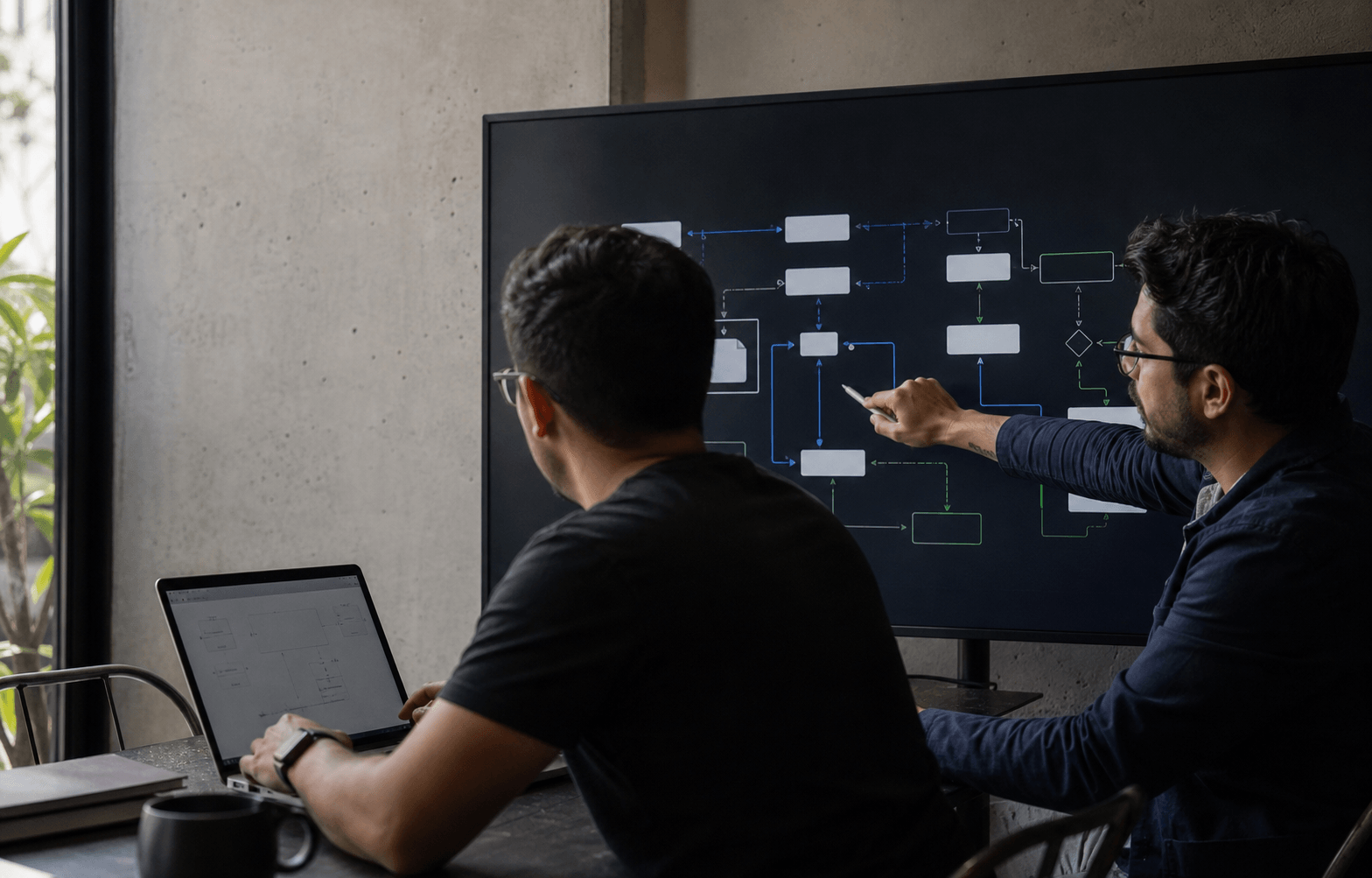
Duplicate entry, critical spreadsheets, approvals in messages, disconnected tools and manual steps consume time and increase risk. Before proposing software, we identify where the operational cost is and what change would make sense.
The same information is entered into more than one system.
A spreadsheet concentrates critical data or decisions.
The team depends on reminders and repetitive manual steps.
Current tools cannot represent the operation’s own rules.
A legacy system prevents important processes from being integrated, measured or improved.
02 / Advantages
Value does not come from accumulating features. It comes from reducing friction, connecting information and giving each person a tool consistent with their responsibility.
Integrations let information travel between systems and reduce the need to repeat work in isolated tools.
The workflow can represent owners, states, validations and exceptions that currently live in messages or informal knowledge.
A useful first version lets teams validate decisions in real context before expanding the scope.
A coherent information structure makes it easier to understand operational status and see where intervention is needed.
Not every existing system must disappear. We evaluate what should be connected, kept, modernized or replaced.
03 / Capabilities
We do not start from a favorite technology. We choose the type of intervention that fits the problem.
Each project combines only what is needed. Scope may begin with an internal system, a focused integration or the measured modernization of an existing platform.
Platforms, internal systems and portals built around specific processes, users, permissions and rules.
A tool that follows the process
Workflows that execute repetitive tasks, move information and trigger actions under clear rules.
Less repetitive manual work
Connections between tools to synchronize data, events and states without duplicate entry.
Systems that stop operating as islands
A measured evolution of legacy software, architecture and interfaces without assuming everything must be replaced at once.
Move forward without ignoring what works
Product design and development when a repeatable problem, market and clear scope exist.
Turn a recurring need into a product
04 / Method
The process reduces uncertainty, makes risk visible and lets every stage be reviewed with evidence.
Map the problem, the people involved, the current workflow and the outcome that matters.
Prioritize scope, risk, integrations and criteria for a useful first release.
Structure the experience, information and architecture around the process.
Deliver in stages so decisions can be reviewed in real context instead of inside a black box.
Agree support and next steps according to the project contract.
05 / Choosing well
Part of our work is distinguishing when to use an existing product, integrate tools, modernize a foundation or develop a dedicated solution.
An existing SaaS solves the problem sufficiently.
Adopt and configure →
The tools work, but they do not share information.
Integrate →
The current foundation works but limits important change.
Modernize in stages →
The operation has its own rules, advantages or processes.
Build custom software →
Bynotek Engineering · Mexico
You do not need to arrive with a technical specification. Share the process, the people involved, the current tools and the outcome you want to enable.
Engineering works remotely with companies and teams in Mexico.